What Was ââåthe Factoryã¢ââ and How Did It Challenge Accepted Notions of Art?


Francis Picabia: left, Le saint des saints c'est de moi qu'il s'agit dans ce portrait, 1 July 1915; centre, Portrait d'une jeune fille americaine dans l'état de nudité, v July 1915; correct, J'ai vu et c'est de toi qu'il south'agit, De Zayas! De Zayas! Je suis venu sur les rivages du Pont-Euxin, New York, 1915

Dada artists, group photograph, 1920, Paris. From left to correct, Back row: Louis Aragon, Theodore Fraenkel, Paul Eluard, Clément Pansaers, Emmanuel Fay (cut off).
Second row: Paul Dermée, Philippe Soupault, Georges Ribemont-Dessaignes.
Front row: Tristan Tzara (with monocle), Celine Arnauld, Francis Picabia, André Breton.
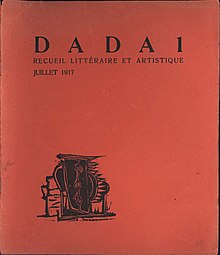
Cover of the outset edition of the publication Dada, Tristan Tzara; Zürich, 1917
Dada () or Dadaism was an art motility of the European avant-garde in the early 20th century, with early centres in Zürich, Switzerland, at the Cabaret Voltaire (c. 1916). New York Dada began c. 1915,[2] [3] and after 1920 Dada flourished in Paris. Dadaist activities lasted until the mid 1920s.
Adult in reaction to World State of war I, the Dada movement consisted of artists who rejected the logic, reason, and aestheticism of modern backer society, instead expressing nonsense, irrationality, and anti-bourgeois protest in their works.[4] [5] [half-dozen] The fine art of the motility spanned visual, literary, and sound media, including collage, sound poetry, cut-up writing, and sculpture. Dadaist artists expressed their discontent toward violence, war, and nationalism, and maintained political affinities with radical left-wing and far-left politics.[7] [viii] [9] [10]
There is no consensus on the origin of the move'due south proper name; a common story is that the German language artist Richard Huelsenbeck slid a paper pocketknife (letter-opener) at random into a dictionary, where it landed on "dada", a colloquial French term for a hobby equus caballus. Jean Arp wrote that Tristan Tzara invented the word at 6 p.grand. on 6 February 1916, in the Café de la Terrasse in Zürich.[11] Others annotation that information technology suggests the first words of a child, evoking a childishness and absurdity that appealed to the group. Still others speculate that the give-and-take might have been chosen to evoke a similar meaning (or no meaning at all) in any linguistic communication, reflecting the movement's internationalism.[12]
The roots of Dada lie in pre-state of war avant-garde. The term anti-art, a precursor to Dada, was coined by Marcel Duchamp effectually 1913 to characterize works that claiming accustomed definitions of art.[13] Cubism and the development of collage and abstruse art would inform the move's disengagement from the constraints of reality and convention. The work of French poets, Italian Futurists and the German Expressionists would influence Dada'due south rejection of the tight correlation betwixt words and meaning.[14] Works such every bit Ubu Roi (1896) by Alfred Jarry and the ballet Parade (1916–17) by Erik Satie would also be characterized every bit proto-Dadaist works.[15] The Dada motility's principles were first collected in Hugo Ball's Dada Manifesto in 1916.
The Dadaist movement included public gatherings, demonstrations, and publication of art/literary journals; passionate coverage of fine art, politics, and culture were topics often discussed in a multifariousness of media. Key figures in the motility included Jean Arp, Johannes Baader, Hugo Ball, Marcel Duchamp, Max Ernst, Elsa von Freytag-Loringhoven, George Grosz, Raoul Hausmann, John Heartfield, Emmy Hennings, Hannah Höch, Richard Huelsenbeck, Francis Picabia, Homo Ray, Hans Richter, Kurt Schwitters, Sophie Taeuber-Arp, Tristan Tzara, and Beatrice Wood, among others. The move influenced later styles like the avant-garde and downtown music movements, and groups including Surrealism, nouveau réalisme, pop art and Fluxus.[ non verified in body ]
Overview [edit]

Francis Picabia, Matriarch! Illustration for the cover of the periodical Dadaphone, n. seven, Paris, March 1920
Dada was an informal international movement, with participants in Europe and North America. The ancestry of Dada correspond with the outbreak of World War I. For many participants, the motility was a protestation against the bourgeois nationalist and colonialist interests, which many Dadaists believed were the root cause of the war, and against the cultural and intellectual conformity—in fine art and more than broadly in society—that corresponded to the war.[16]
Avant-garde circles outside France knew of pre-war Parisian developments. They had seen (or participated in) Cubist exhibitions held at Galeries Dalmau, Barcelona (1912), Galerie Der Sturm in Berlin (1912), the Arsenal Prove in New York (1913), SVU Mánes in Prague (1914), several Jack of Diamonds exhibitions in Moscow and at Moderne Kunstkring, Amsterdam (between 1911 and 1915). Futurism adult in response to the work of various artists. Dada after combined these approaches.[fourteen] [17]
Many Dadaists believed that the 'reason' and 'logic' of bourgeois backer society had led people into war. They expressed their rejection of that credo in creative expression that appeared to reject logic and comprehend anarchy and irrationality.[v] [vi] For example, George Grosz afterward recalled that his Dadaist art was intended as a protest "against this globe of common devastation".[5]
According to Hans Richter Dada was not art: information technology was "anti-art."[16] Dada represented the reverse of everything which art stood for. Where art was concerned with traditional aesthetics, Dada ignored aesthetics. If art was to appeal to sensibilities, Dada was intended to offend.
Additionally, Dada attempted to reflect onto human perception and the cluttered nature of society. Tristan Tzara proclaimed, "Everything is Dada, too. Beware of Dada. Anti-dadaism is a disease: selfkleptomania, man's normal condition, is Dada. But the real Dadas are against Dada".[18]
Equally Hugo Brawl expressed it, "For us, fine art is not an end in itself ... but information technology is an opportunity for the true perception and criticism of the times nosotros live in."[19]
A reviewer from the American Art News stated at the time that "Dada philosophy is the sickest, nearly paralyzing and nearly subversive thing that has ever originated from the brain of homo." Art historians have described Dada as beingness, in big part, a "reaction to what many of these artists saw equally nothing more than than an insane spectacle of collective homicide".[twenty]
Years later on, Dada artists described the movement as "a phenomenon bursting forth in the midst of the postwar economical and moral crunch, a savior, a monster, which would lay waste to everything in its path... [It was] a systematic piece of work of destruction and demoralization... In the finish it became nothing but an act of sacrilege."[twenty]
To quote Dona Budd's The Language of Art Knowledge,
Dada was built-in out of negative reaction to the horrors of the Start World War. This international movement was begun past a group of artists and poets associated with the Cabaret Voltaire in Zürich. Dada rejected reason and logic, prizing nonsense, irrationality and intuition. The origin of the name Dada is unclear; some believe that information technology is a nonsensical word. Others maintain that information technology originates from the Romanaian artists Tristan Tzara's and Marcel Janco's frequent apply of the words "da, da," meaning "yeah, aye" in the Romanaian language. Some other theory says that the proper noun "Dada" came during a coming together of the group when a newspaper knife stuck into a French–High german dictionary happened to point to 'dada', a French word for 'hobbyhorse'.[6]
The movement primarily involved visual arts, literature, poetry, art manifestos, fine art theory, theatre, and graphic design, and concentrated its anti-war politics through a rejection of the prevailing standards in art through anti-art cultural works.
The creations of Duchamp, Picabia, Man Ray, and others between 1915 and 1917 eluded the term Dada at the time, and "New York Dada" came to be seen as a mail facto invention of Duchamp. At the offset of the 1920s the term Dada flourished in Europe with the help of Duchamp and Picabia, who had both returned from New York. Notwithstanding, Dadaists such every bit Tzara and Richter claimed European precedence. Art historian David Hopkins notes:
Ironically, though, Duchamp's belatedly activities in New York, along with the machinations of Picabia, re-cast Dada's history. Dada's European chroniclers—primarily Richter, Tzara, and Huelsenbeck—would eventually go preoccupied with establishing the pre-eminence of Zurich and Berlin at the foundations of Dada, but it proved to be Duchamp who was most strategically brilliant in manipulating the genealogy of this avant-garde formation, deftly turning New York Dada from a late-comer into an originating strength.[21]
History [edit]
Dada emerged from a period of creative and literary movements like Futurism, Cubism and Expressionism; centered mainly in Italy, France and Germany respectively, in those years. However, unlike the earlier movements Dada was able to institute a broad base of support, giving rise to a movement that was international in telescopic. Its adherents were based in cities all over the world including New York, Zürich, Berlin, Paris and others. There were regional differences similar an emphasis on literature in Zürich and political protestation in Berlin.[22]
Prominent Dadaists published manifestos, merely the motility was loosely organized and there was no primal hierarchy. On 14 July 1916, Ball originated the seminal manifesto. Tzara wrote a second Dada manifesto,[23] [24] considered important Dada reading, which was published in 1918.[25] Tzara'due south manifesto articulated the concept of "Dadaist disgust"—the contradiction implicit in advanced works betwixt the criticism and affirmation of modernist reality. In the Dadaist perspective modern fine art and culture are considered a type of fetishization where the objects of consumption (including organized systems of idea like philosophy and morality) are chosen, much similar a preference for cake or cherries, to fill a void.[26]
The shock and scandal the move inflamed was deliberate; Dadist magazines were banned and their exhibits closed. Some of the artists even faced imprisonment. These provocations were part of the entertainment only, over time, audiences' expectations eventually outpaced the move'due south chapters to deliver. Equally the artists' well-known "sarcastic laugh" started to come from the audience, the provocations of Dadaists began to lose their impact. Dada was an agile motility during years of political turmoil from 1916 when European countries were actively engaged in Globe War I, the conclusion of which, in 1918, prepare the stage for a new political order.[27]
Zürich [edit]
There is some disagreement about where Dada originated. The movement is commonly accepted past most art historians and those who lived during this period to have identified with the Cabaret Voltaire (housed inside the Holländische Meierei bar in Zürich) co-founded by poet and cabaret singer Emmy Hennings and Hugo Ball.[28] Some sources propose a Romanian origin, arguing that Dada was an offshoot of a vibrant artistic tradition that transposed to Switzerland when a group of Jewish modernist artists, including Tristan Tzara, Marcel Janco, and Arthur Segal settled in Zürich. Before World War I, similar art had already existed in Bucharest and other Eastern European cities; it is probable that Dada'due south catalyst was the arrival in Zürich of artists like Tzara and Janco.[29]
The proper noun Cabaret Voltaire was a reference to the French philosopher Voltaire, whose novel Candide mocked the religious and philosophical dogmas of the day. Opening dark was attended by Brawl, Tzara, Jean Arp, and Janco. These artists along with others like Sophie Taeuber, Richard Huelsenbeck and Hans Richter started putting on performances at the Cabaret Voltaire and using art to express their cloy with the war and the interests that inspired it. Having left Germany and Romania during Globe State of war I, the artists arrived in politically neutral Switzerland. They used brainchild to fight confronting the social, political, and cultural ideas of that fourth dimension. They used daze fine art, provocation, and "vaudevilleian excess" to subvert the conventions they believed had acquired the Dandy State of war.[30] The Dadaists believed those ideas to be a byproduct of bourgeois order that was and so apathetic information technology would wage war confronting itself rather than claiming the status quo:[31]
We had lost confidence in our civilization. Everything had to be demolished. We would begin again after the tabula rasa. At the Cabaret Voltaire we began past shocking common sense, public stance, instruction, institutions, museums, adept sense of taste, in short, the whole prevailing order."
—Marcel Janco[32]
Ball said that Janco'south mask and costume designs, inspired past Romanian folk fine art, made "the horror of our time, the paralyzing background of events" visible.[30] Co-ordinate to Ball, performances were accompanied past a "balalaika orchestra playing delightful folk-songs". Influenced past African music, arrhythmic drumming and jazz were common at Dada gatherings.[33] [34]
Afterwards the cabaret closed down, Dada activities moved on to a new gallery, and Hugo Ball left for Bern. Tzara began a relentless entrada to spread Dada ideas. He bombarded French and Italian artists and writers with letters, and soon emerged as the Dada leader and master strategist. The Cabaret Voltaire re-opened, and is still in the same place at the Spiegelgasse 1 in the Niederdorf.
Zürich Dada, with Tzara at the captain, published the art and literature review Dada showtime in July 1917, with five editions from Zürich and the final two from Paris.
Other artists, such every bit André Breton and Philippe Soupault, created "literature groups to help extend the influence of Dada".[35]
After the fighting of the First Earth War had ended in the armistice of Nov 1918, virtually of the Zürich Dadaists returned to their home countries, and some began Dada activities in other cities. Others, such every bit the Swiss native Sophie Taeuber, would remain in Zürich into the 1920s.
Berlin [edit]

Cover of Anna Blume, Dichtungen, 1919
"Berlin was a metropolis of tightened stomachers, of mounting, thundering hunger, where hidden rage was transformed into a boundless money lust, and men'southward minds were concentrating more than and more on questions of naked being... Fear was in everybody'southward basic" – Richard Hülsenbeck
Raoul Hausmann, who helped institute Dada in Berlin, published his manifesto Synthethic Cino of Painting in 1918 where he attacked Expressionism and the art critics who promoted it. Dada is envisioned in contrast to fine art forms, such as Expressionism, that appeal to viewers' emotional states: "the exploitation of so-chosen echoes of the soul". In Hausmann'due south formulation of Dada, new techniques of creating art would open doors to explore new artistic impulses. Fragmented apply of existent earth stimuli allowed an expression of reality that was radically different from other forms of fine art:[36]
A kid's discarded doll or a brightly colored rag are more necessary expressions than those of some ass who seeks to immortalize himself in oils in finite parlors.
—Raoul Hausmann
The groups in Federal republic of germany were not every bit strongly anti-art as other groups. Their action and fine art were more than political and social, with corrosive manifestos and propaganda, satire, public demonstrations and overt political activities. The intensely political and war-torn environment of Berlin had a dramatic impact on the ideas of Berlin Dadaists. Conversely, New York's geographic altitude from the war spawned its more theoretically-driven, less political nature.[37] According to Hans Richter, a Dadaist who was in Berlin withal "aloof from active participation in Berlin Dada", several distinguishing characteristics of the Dada movement at that place included: "its political element and its technical discoveries in painting and literature"; "inexhaustible energy"; "mental liberty which included the abolitionism of everything"; and "members intoxicated with their own power in a manner that had no relation to the real world", who would "turn their rebelliousness fifty-fifty confronting each other".[38]
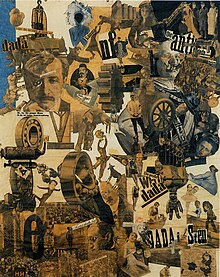
In February 1918, while the Slap-up War was approaching its climax, Huelsenbeck gave his first Dada speech in Berlin, and he produced a Dada manifesto later in the yr. Post-obit the October Revolution in Russia, by then out of the war, Hannah Höch and George Grosz used Dada to express communist sympathies. Grosz, together with John Heartfield, Höch and Hausmann developed the technique of photomontage during this period. Johannes Baader, the uninhibited Oberdada, was the "crowbar" of the Berlin movement's direct action co-ordinate to Hans Richter and is credited with creating the start giant collages, according to Raoul Hausmann.
Later the war, the artists published a series of brusk-lived political magazines and held the First International Dada Fair, 'the greatest projection however conceived by the Berlin Dadaists', in the summertime of 1920.[39] As well as work by the main members of Berlin Dada – Grosz, Raoul Hausmann, Hannah Höch, Johannes Baader, Huelsenbeck and Heartfield – the exhibition likewise included the piece of work of Otto Dix, Francis Picabia, Jean Arp, Max Ernst, Rudolf Schlichter, Johannes Baargeld and others.[39] In all, over 200 works were exhibited, surrounded by incendiary slogans, some of which as well concluded up written on the walls of the Nazi'due south Entartete Kunst exhibition in 1937. Despite high ticket prices, the exhibition lost money, with only one recorded sale.[40]
The Berlin group published periodicals such equally Club Dada, Der Dada, Lowest His Own Football, and Dada Almanach. They as well established a political party, the Central Council of Dada for the Globe Revolution.
Cologne [edit]
In Cologne, Ernst, Baargeld, and Arp launched a controversial Dada exhibition in 1920 which focused on nonsense and anti-bourgeois sentiments. Cologne'southward Early on Leap Exhibition was prepare up in a pub, and required that participants walk past urinals while being read lewd poetry past a woman in a communion dress. The police closed the exhibition on grounds of obscenity, merely it was re-opened when the charges were dropped.[41]
New York [edit]

Like Zürich, New York City was a refuge for writers and artists from the Beginning World State of war. Soon after arriving from France in 1915, Marcel Duchamp and Francis Picabia met American artist Man Ray. Past 1916 the three of them became the eye of radical anti-art activities in the United states of america. American Beatrice Wood, who had been studying in France, soon joined them, along with Elsa von Freytag-Loringhoven. Arthur Cravan, fleeing conscription in France, was too in New York for a fourth dimension. Much of their activity centered in Alfred Stieglitz's gallery, 291, and the domicile of Walter and Louise Arensberg.
The New Yorkers, though not particularly organized, called their activities Dada, but they did not issue manifestos. They issued challenges to art and culture through publications such equally The Blind Human, Rongwrong, and New York Dada in which they criticized the traditionalist basis for museum art. New York Dada lacked the disillusionment of European Dada and was instead driven by a sense of irony and humor. In his volume Adventures in the arts: breezy chapters on painters, vaudeville and poets Marsden Hartley included an essay on "The Importance of Being 'Dada' ".
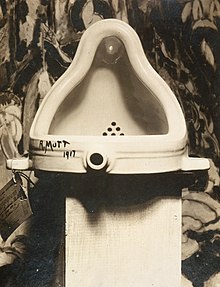
During this time Duchamp began exhibiting "readymades" (everyday objects plant or purchased and alleged art) such as a canteen rack, and was agile in the Society of Independent Artists. In 1917 he submitted the at present famous Fountain, a urinal signed R. Mutt, to the Lodge of Contained Artists exhibition but they rejected the piece. First an object of scorn within the arts community, the Fountain has since become almost canonized by some[42] equally one of the almost recognizable modernist works of sculpture. Fine art globe experts polled by the sponsors of the 2004 Turner Prize, Gordon'due south gin, voted it "the most influential work of modern art".[42] [43] As recent scholarship documents, the work is nevertheless controversial. Duchamp indicated in a 1917 letter of the alphabet to his sister that a female friend was centrally involved in the conception of this work: "I of my female friends who had adopted the pseudonym Richard Mutt sent me a porcelain urinal as a sculpture."[44] The piece is in line with the scatological aesthetics of Duchamp's neighbour, the Baroness Elsa von Freytag-Loringhoven.[45] In an try to "pay homage to the spirit of Dada" a performance creative person named Pierre Pinoncelli fabricated a fissure in a replica of The Fountain with a hammer in Jan 2006; he as well urinated on it in 1993.
Picabia's travels tied New York, Zürich and Paris groups together during the Dadaist period. For seven years he besides published the Dada journal 391 in Barcelona, New York City, Zürich, and Paris from 1917 through 1924.
By 1921, most of the original players moved to Paris where Dada had experienced its last major incarnation.
Paris [edit]

Man Ray, c. 1921–22, Rencontre dans la porte tournante, published on the cover of Der Sturm, Book 13, Number three, 5 March 1922

Man Ray, c. 1921–22, Dessin (Drawing), published on folio 43 of Der Sturm, Book 13, Number 3, v March 1922
The French avant-garde kept abreast of Dada activities in Zürich with regular communications from Tristan Tzara (whose pseudonym means "sad in country," a name chosen to protest the handling of Jews in his native Romania), who exchanged letters, poems, and magazines with Guillaume Apollinaire, André Breton, Max Jacob, Clément Pansaers, and other French writers, critics and artists.
Paris had arguably been the classical music upper-case letter of the earth since the advent of musical Impressionism in the tardily 19th century. One of its practitioners, Erik Satie, collaborated with Picasso and Cocteau in a mad, scandalous ballet called Parade. Commencement performed by the Ballets Russes in 1917, it succeeded in creating a scandal merely in a different way than Stravinsky's Le Sacre du printemps had washed almost five years earlier. This was a ballet that was clearly parodying itself, something traditional ballet patrons would obviously accept serious issues with.
Dada in Paris surged in 1920 when many of the originators converged in that location. Inspired by Tzara, Paris Dada soon issued manifestos, organized demonstrations, staged performances and produced a number of journals (the final two editions of Dada, Le Cannibale, and Littérature featured Dada in several editions.)[46]
The first introduction of Dada artwork to the Parisian public was at the Salon des Indépendants in 1921. Jean Crotti exhibited works associated with Dada including a work entitled, Explicatif bearing the word Tabu. In the same twelvemonth Tzara staged his Dadaist play The Gas Heart to howls of derision from the audience. When it was re-staged in 1923 in a more than professional person production, the play provoked a theatre riot (initiated by André Breton) that heralded the carve up inside the movement that was to produce Surrealism. Tzara's last endeavour at a Dadaist drama was his "ironic tragedy" Handkerchief of Clouds in 1924.
Netherlands [edit]
In holland the Dada movement centered mainly effectually Theo van Doesburg, best known for establishing the De Stijl movement and magazine of the same name. Van Doesburg mainly focused on poetry, and included poems from many well-known Dada writers in De Stijl such as Hugo Ball, Hans Arp and Kurt Schwitters. Van Doesburg and Thijs Rinsema (a cordwainer and artist in Drachten) became friends of Schwitters, and together they organized the so-called Dutch Dada entrada in 1923, where van Doesburg promoted a leaflet nearly Dada (entitled What is Dada?), Schwitters read his poems, Vilmos Huszár demonstrated a mechanical dancing doll and Nelly van Doesburg (Theo's wife), played advanced compositions on piano.

A Bonset sound-verse form, "Passing troop", 1916
Van Doesburg wrote Dada poetry himself in De Stijl, although nether a pseudonym, I.K. Bonset, which was just revealed afterwards his death in 1931. 'Together' with I.K. Bonset, he also published a short-lived Dutch Dada magazine called Mécano (1922–3). Another Dutchman identified by K. Schippers in his study of the movement in the Netherlands[47] was the Groningen typographer H. North. Werkman, who was in touch with van Doesburg and Schwitters while editing his own magazine, The Adjacent Call (1923–half dozen). Two more artists mentioned by Schippers were High german-built-in and eventually settled in the Netherlands. These were Otto van Rees, who had taken part in the liminal exhibitions at the Café Voltaire in Zürich, and Paul Citroen.
Georgia [edit]
Though Dada itself was unknown in Georgia until at to the lowest degree 1920, from 1917 until 1921 a group of poets called themselves "41st Degree" (referring both to the latitude of Tbilisi, Georgia and to the Celsius temperature of a high fever [equal to 105.8 Fahrenheit]) organized along Dadaist lines. The most of import figure in this grouping was Iliazd (Ilia Zdanevich), whose radical typographical designs visually repeat the publications of the Dadaists. After his flight to Paris in 1921, he collaborated with Dadaists on publications and events. For instance, when Tristan Tzara was banned from holding seminars in Théâtre Michel in 1923, Iliazd booked the venue on his behalf for the performance, "The Bearded Heart Soirée", and designed the flyer.[48]
Yugoslavia [edit]
In Yugoslavia, alongside the new fine art motility Zenitism, there was significant Dada activity betwixt 1920 and 1922, run mainly past Dragan Aleksić and including work by Mihailo South. Petrov, Ljubomir Micić and Branko Ve Poljanski.[49] Aleksić used the term "Yougo-Dada" and is known to have been in contact with Raoul Hausmann, Kurt Schwitters, and Tristan Tzara.[50] [51]
Italy [edit]
The Dada movement in Italian republic, based in Mantua, was met with distaste and failed to make a meaning bear upon in the world of art. It published a magazine for a short time and held an exhibition in Rome, featuring paintings, quotations from Tristan Tzara, and original epigrams such equally "True Dada is against Dada". One fellow member of this group was Julius Evola, who went on to become an eminent scholar of occultism, also equally a correct-fly philosopher.[52]
Nihon [edit]
A prominent Dada group in Nihon was Mavo, founded in July 1923 by Tomoyoshi Murayama, and Yanase Masamu later joined by Tatsuo Okada. Other prominent artists were Jun Tsuji, Eisuke Yoshiyuki, Shinkichi Takahashi and Katué Kitasono.

Dada, an iconic grapheme from the Ultra Serial. His blueprint draws inspiration from the art move.
In Tsuburaya Productions's Ultra Series, an alien named Dada was inspired past the Dadaism movement, with said character beginning appearing in episode 28 of the 1966 tokusatsu series, Ultraman, its pattern by character artist Toru Narita. Dada's design is primarily monochromatic, and features numerous sharp lines and alternating blackness and white stripes, in reference to the move and, in particular, to chessboard and Go patterns. On May 19, 2016, in commemoration to the 100 yr anniversary of Dadaism in Tokyo, the Ultra Monster was invited to come across the Swiss Administrator Urs Bucher.[53] [54]
Butoh, the Japanese trip the light fantastic-form originating in 1959, can be considered to have directly connections to the spirit of the Dada movement, as Tatsumi Hijikata, ane of Butoh's founders, "was influenced early in his career by Dadaism".[55]
Russia [edit]
Dada in itself was relatively unknown in Russia, nevertheless, advanced art was widespread due to the Bolshevik's revolutionary agenda. The Nichevoki, a literary group sharing Dadaist ethics[56] achieved infamy after one of its members suggested that Vladimir Mayakovsky should go to the "Pampushka" (Pameatnik Pushkina – Pushkin monument) on the "Tverbul" (Tverskoy Boulevard) to clean the shoes of anyone who desired it, after Mayakovsky declared that he was going to cleanse Russian literature.[56] For more data on Dadaism's influence upon Russian avant-garde art, see the book Russian Dada 1914–1924.[57]
Women of Dada [edit]
Often disregarded when discussing the history and foundations of Dada, information technology is necessary to shed lite on the female person artists who created and inspired art and artists akin. These women were often times in ideal or romantic relationships with the male Dadaists mentioned above merely are rarely written past the relative ties. Still, each artist fabricated vital contributions to the movement. Other notable mentions that do not include the artists below are: Suzanne Duchamp, Elsa von Freytag-Loringhoven, Emmy Hennings, Beatrice Wood, Clara Tice, and Ella Bergmann-Michel.
Hannah Höch [edit]
Hannah Höch of Berlin is considered to be the only female Dadaist in Berlin at the time of the movement.[58] During this time, she was in a relationship with Raoul Hausmann who also was a Dada artist. She channeled the same anti-war and anti-government (Weimar Commonwealth) in her works but brought out a feminist lens on the themes. With her works primarily of collage and photomontage, she often used precise placement or detailed titles to callout the misogynistic means she and other women were treated.[59]
Sophie Taeuber-Arp [edit]
Sophie Taeuber-Arp was a Swiss artist, teacher, and dancer who produced various types of fine art and handicraft pieces. While married to Dadaist Jean Arp, Taeuber-Arp was known in the Dada community for her performative dancing. Every bit such, she worked with choreographer Rudolf von Laban and was written by Tristan Tarza for her dancing skills.
Mina Loy [edit]
London-born Mina Loy was known for being active in the literary sector of the New York Dada scene. She spent time writing poetry, creating Dada magazines, and acting and writing in plays. She contributed writing to Dada journal The Blind Man and Marchel Duchamp's Rongwrong.
Poetry [edit]

Dadaglobe solicitation form letter signed past Francis Picabia, Tristan Tzara, Georges Ribemont-Dessaignes, and Walter Serner, c. week of November viii, 1920. This example was sent from Paris to Alfred Vagts in Munich.
Dadists used stupor, nihilism, negativity, paradox, randomness, hidden forces and antinomianism to subvert established traditions in the aftermath of the Great War. Tzara'south 1920 manifesto proposed cutting words from a newspaper and randomly selecting fragments to write poetry, a process in which the synchronous universe itself becomes an active agent in creating the art. A poem written using this technique would be a "fruit" of the words that were clipped from the commodity.[60]
In literary arts Dadaists focused on poetry, particularly the so-called sound verse invented by Hugo Ball. Dadaist poems attacked traditional conceptions of verse, including structure, social club, every bit well as the interplay of audio and the meaning of linguistic communication. For Dadaists, the existing system by which information is articulated robs language of its dignity. The dismantling of linguistic communication and poetic conventions are Dadaist attempts to restore language to its purest and most innocent form: "With these sound verse form, we wanted to dispense with a linguistic communication which journalism had made desolate and incommunicable."[61]
Simultaneous poems (or poèmes simultanés) were recited past a group of speakers who, collectively, produced a chaotic and confusing gear up of voices. These poems are considered manifestations of modernity including advertising, technology, and conflict. Unlike movements such every bit Expressionism, Dadaism did not take a negative view of modernity and the urban life. The chaotic urban and futuristic world is considered natural terrain that opens up new ideas for life and art.[62]
Music [edit]
Dada was not confined to the visual and literary arts; its influence reached into sound and music. These movements exerted a pervasive influence on 20th-century music, especially on mid-century avant-garde composers based in New York—among them Edgard Varèse, Stefan Wolpe, John Cage, and Morton Feldman.[63] Kurt Schwitters developed what he called sound poems, while Francis Picabia and Georges Ribemont-Dessaignes composed Dada music performed at the Festival Dada in Paris on 26 May 1920.[64] Other composers such equally Erwin Schulhoff, Hans Heusser and Alberto Savinio all wrote Dada music,[65] while members of Les Six collaborated with members of the Dada motility and had their works performed at Dada gatherings. Erik Satie also dabbled with Dadaist ideas during his career, although he is primarily associated with musical Impressionism.[64]
Legacy [edit]
While broadly based, the movement was unstable. Past 1924 in Paris, Dada was melding into Surrealism, and artists had gone on to other ideas and movements, including Surrealism, social realism and other forms of modernism. Some theorists debate that Dada was really the beginning of postmodern art.[66]
By the dawn of the Second World War, many of the European Dadaists had emigrated to the United States. Some (Otto Freundlich, Walter Serner) died in death camps under Adolf Hitler, who actively persecuted the kind of "degenerate art" that he considered Dada to represent. The motility became less active as mail service-war optimism led to the development of new movements in art and literature.
Dada is a named influence and reference of various anti-art and political and cultural movements, including the Situationist International and civilization jamming groups similar the Cacophony Social club. Upon breaking up in July 2012, agitator pop band Chumbawamba issued a statement which compared their ain legacy with that of the Dada fine art movement.[67]
At the same time that the Zürich Dadaists were making noise and spectacle at the Cabaret Voltaire, Lenin was planning his revolutionary plans for Russia in a nearby apartment. Tom Stoppard used this coincidence as a premise for his play Travesties (1974), which includes Tzara, Lenin, and James Joyce as characters. French writer Dominique Noguez imagined Lenin as a member of the Dada group in his tongue-in-cheek Lénine Dada (1989).
The former building of the Cabaret Voltaire savage into busted until it was occupied from January to March 2002, by a group proclaiming themselves Neo-Dadaists, led by Mark Divo.[68] The group included January Thieler, Ingo Giezendanner, Aiana Calugar, Lennie Lee, and Dan Jones. After their eviction, the space was turned into a museum defended to the history of Dada. The work of Lee and Jones remained on the walls of the new museum.
Several notable retrospectives have examined the influence of Dada upon art and social club. In 1967, a big Dada retrospective was held in Paris. In 2006, the Museum of Modern Art in New York City mounted a Dada exhibition in partnership with the National Gallery of Art in Washington D.C. and the Centre Pompidou in Paris. The LTM characterization has released a large number of Dada-related sound recordings, including interviews with artists such every bit Tzara, Picabia, Schwitters, Arp, and Huelsenbeck, and musical repertoire including Satie, Ribemont-Dessaignes, Picabia, and Nelly van Doesburg.[69]
Musician Frank Zappa was a cocky-proclaimed Dadaist afterward learning of the movement:
In the early on days, I didn't fifty-fifty know what to telephone call the stuff my life was made of. You can imagine my delight when I discovered that someone in a distant land had the same idea—AND a nice, short name for it.[lxx]
David Bowie adapted William S. Burrough's cut-up technique for writing lyrics and Kurt Cobain also admittedly used this method for many of his Nirvana lyrics, including "In Bloom".[71]
Art techniques developed [edit]
Dadaism too blurred the line between literary and visual arts:
Dada is the background to abstruse art and sound poetry, a starting point for performance art, a prelude to postmodernism, an influence on pop art, a celebration of antiart to exist later embraced for anarcho-political uses in the 1960s and the movement that laid the foundation for Surrealism.[72]
Collage [edit]
The Dadaists imitated the techniques developed during the cubist motility through the pasting of cutting pieces of paper items, but extended their art to cover items such as transportation tickets, maps, plastic wrappers, etc. to portray aspects of life, rather than representing objects viewed equally yet life. They also invented the "adventure collage" technique, involving dropping torn scraps of newspaper onto a larger sail and and then pasting the pieces wherever they landed.
Cutting-upwards technique [edit]
Cutting-up technique is an extension of collage to words themselves, Tristan Tzara describes this in the Dada Manifesto:[73]
TO Make A DADAIST Verse form
Take a newspaper.
Have some scissors.
Choose from this paper an article of the length you desire to make your poem.
Cut out the article.
Next advisedly cut out each of the words that makes up this article and put them all in a purse.
Milk shake gently.
Next have out each cutting i after the other.
Re-create conscientiously in the order in which they left the bag.
The poem volition resemble you.
And there yous are – an infinitely original author of charming sensibility, fifty-fifty though unappreciated by the vulgar herd.
Photomontage [edit]
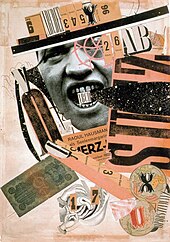
Raoul Hausmann, ABCD (cocky-portrait), a photomontage from 1923–24
The Dadaists – the "monteurs" (mechanics) – used scissors and glue rather than paintbrushes and paints to express their views of modern life through images presented by the media. A variation on the collage technique, photomontage utilized bodily or reproductions of real photographs printed in the press. In Cologne, Max Ernst used images from the Commencement World War to illustrate messages of the destruction of war.[74] Although the Berlin photomontages were assembled, like engines, the (non)relationships amidst the disparate elements were more rhetorical than existent.[75]
Aggregation [edit]
The assemblages were 3-dimensional variations of the collage – the associates of everyday objects to produce meaningful or meaningless (relative to the war) pieces of work including war objects and trash. Objects were nailed, screwed or fastened together in dissimilar fashions. Assemblages could be seen in the round or could be hung on a wall.[76]
Readymades [edit]
Marcel Duchamp began to view the manufactured objects of his drove as objects of art, which he called "readymades". He would add together signatures and titles to some, converting them into artwork that he called "readymade aided" or "rectified readymades". Duchamp wrote: "One important characteristic was the short sentence which I occasionally inscribed on the 'readymade.' That sentence, instead of describing the object like a title, was meant to carry the mind of the spectator towards other regions more verbal. Sometimes I would add a graphic particular of presentation which in gild to satisfy my craving for alliterations, would be called 'readymade aided.'"[77] Ane such example of Duchamp's readymade works is the urinal that was turned onto its back, signed "R. Mutt", titled Fountain, and submitted to the Lodge of Independent Artists exhibition that year, though it was not displayed.
Many young artists in America embraced the theories and ideas espoused past Duchamp. Robert Rauschenberg in particular was very influenced past Dadaism and tended to utilize found objects in his collages as a means of dissolving the boundary betwixt high and depression culture.[78]
Artists [edit]
- Dragan Aleksić (1901–1958), Yugoslavia
- Louis Aragon (1897–1982), France
- Jean Arp (1886–1966), Germany, France
- Sophie Taeuber-Arp (1889–1943) Switzerland, France
- Johannes Baader (1875–1955) Germany
- Hugo Ball (1886–1927), Germany, Switzerland
- André Breton (1896–1966), France
- John Covert (painter) (1882–1960), United states of america
- Jean Crotti (1878–1958), France
- Otto Dix (1891–1969), Federal republic of germany
- Theo van Doesburg (1883–1931) Netherlands
- Marcel Duchamp (1887–1968), France
- Suzanne Duchamp (1889–1963), France
- Paul Éluard (1895–1952), French republic
- Max Ernst (1891–1976), Frg, The states
- Julius Evola (1898–1974), Italian republic
- George Grosz (1893–1959), Germany, French republic, United states of america
- Raoul Hausmann (1886–1971), Deutschland
- John Heartfield (1891–1968), Germany, USSR, Czechoslovakia, Uk
- Hannah Höch (1889–1978), Germany
- Richard Huelsenbeck (1892–1974), Frg
- Georges Hugnet (1906–1974), French republic
- Marcel Janco (1895–1984), Romania, State of israel
- Elsa von Freytag-Loringhoven (1874–1927), Germany, US
- Clément Pansaers (1885–1922), Belgium
- Francis Picabia (1879–1953), France
- Man Ray (1890–1976), France, United states
- Georges Ribemont-Dessaignes (1884–1974), French republic
- Hans Richter, Germany, Switzerland
- Juliette Roche Gleizes (1884–1980), France
- Kurt Schwitters (1887–1948), Germany
- Walter Serner (1889–1942), Austria
- Philippe Soupault (1897–1990), France
- Tristan Tzara (1896–1963), Romania, French republic
- Beatrice Woods (1893–1998), US
Come across also [edit]
- Art intervention
- Dadaglobe
- List of Dadaists
- Épater la bourgeoisie
- Happening
- Incoherents
- Transgressive art
- Devastation Was My Beatrice, history by Jed Resula
References [edit]
- ^ World War I and Dada Archived 2017-12-01 at the Wayback Machine, Museum of Modern Art (MoMA).
- ^ Francis M. Naumann, New York Dada, 1915–23 Archived 2018-10-28 at the Wayback Machine, Abrams, 1994, ISBN 0-81093676-3
- ^ Mario de Micheli (2006). Las vanguardias artísticas del siglo Twenty. Alianza Forma. pp. 135–37.
- ^ Trachtman, Paul. "A Brief History of Dada". Smithsonian Mag. Archived from the original on sixteen January 2017. Retrieved xiv January 2017.
- ^ a b c Schneede, Uwe M. (1979), George Grosz, His life and work, New York: Universe Books
- ^ a b c Budd, Dona, The Language of Art Knowledge, Pomegranate Communications.
- ^ Richard Huelsenbeck, En avant Dada: Eine Geschichte des Dadaismus, Paul Steegemann Verlag, Hannover, 1920, Erste Ausgabe (Dice Silbergäule): English translation in Motherwell 1951, p.[ page needed ]
- ^ "Dada, Tate". Archived from the original on 2014-10-26. Retrieved 2014-10-26 .
- ^ Timothy Stroud, Emanuela Di Lallo, 'Art of the Twentieth Century: 1900–1919, the avant-garde movements', Book one of Art of the Twentieth Century, Skyra, 2006, ISBN 887624604-five
- ^ Middleton, J. C. (1962). "'Bolshevism in Fine art': Dada and Politics". Texas Studies in Literature and Language. 4 (3): 408–30. JSTOR 40753524.
- ^ Ian Chilvers; John Glaves-Smith, eds. (2009). "Dada". A Dictionary of Modern and Contemporary Art. Oxford University Press. pp. 171–173. ISBN9780199239658. Archived from the original on 2021-03-02. Retrieved 2021-02-13 .
- ^ Dada Archived 2017-01-xxx at the Wayback Auto, The art history, retrieved March xiii, 2017.
- ^ "Anti-fine art, Art that challenges the existing accepted definitions of art, Tate". Archived from the original on 2017-04-05. Retrieved 2014-10-26 .
- ^ a b "Dada", Dawn Adès and Matthew Gale, Grove Art Online, Oxford University Press, 2009 (subscription required) Archived 2018-03-12 at the Wayback Motorcar
- ^ Roselee Goldberg, Thomas & Hudson, L'univers de l'art, Chapter 4, Le surréalisme, Les représentations pré-Dada à Paris, ISBN 978-2-87811-380-viii
- ^ a b Richter, Hans (1965), Dada: Art and Anti-fine art, New York and Toronto: Oxford University Printing
- ^ Joan M. Marter, The Grove Encyclopedia of American Art, Book i, Oxford University Press, 2011 Archived 2020-02-09 at the Wayback Car, p. vi, ISBN 0195335791
- ^ Tzara, Tristan (1920). "VII". La Vie des Lettres (in French). Paris.
- ^ DADA: Cities, National Gallery of Art, archived from the original on 2008-11-02, retrieved 2008-x-nineteen
- ^ a b Fred S. Kleiner (2006), Gardner'due south Art Through the Ages (twelfth ed.), Wadsworth Publishing, p. 754
- ^ Hopkins, David, A Companion to Dada and Surrealism, Volume 10 of Blackwell Companions to Art History, John Wiley & Sons, May two, 2016, p. 83, ISBN 1118476182
- ^ Elger 2004, p. 6.
- ^ Motherwell 1951, p.[ page needed ].
- ^ "Tristan Tzara: Dada Manifesto 1918" Archived 2020-11-30 at the Wayback Machine (text Archived 2021-04-14 at the Wayback Auto) by Charles Cramer and Kim Grant, Khan Academy
- ^ Wellek, René (1955). A History of Modern Criticism: French, Italian and Spanish criticism, 1900-1950 . Yale University Press. p. 91. ISBN9780300054514.
Tzara second Dada manifesto,.
- ^ Novero, Cecilia (2010). Antidiets of the Avant-garde. University of Minnesota Press. p. 62.
- ^ Elger 2004, p. vii.
- ^ Greeley, Anne. "Cabaret Voltaire". Routledge. Archived from the original on 31 July 2019. Retrieved 31 July 2019.
- ^ Tom Sandqvist, Dada Eastward: The Romanians of Cabaret Voltaire, London MIT Press, 2006.[ page needed ]
- ^ a b "Cabaret Voltaire: A Nighttime Out at History'south Wildest Nightclub". BBC. 2016. Archived from the original on 31 July 2019. Retrieved 31 July 2019.
- ^ "Introduction: "Everybody can Dada"". National Gallery of Art. Archived from the original on two Nov 2008. Retrieved 10 May 2012.
- ^ Marcel Janco, "Dada at Ii Speeds," trans. in Lucy R. Lippard, Dadas on Art (Englewood Cliffs, New Bailiwick of jersey, 1971), p. 36.
- ^ Jenkins, Ellen January (2011). Andrea, Alfred J. (ed.). World History Encyclopedia. ABC-CLIO – via Credo Reference.
- ^ Rasula, Jed (2015). Destruction was My Beatrice: Dada and the Unmaking of the Twentieth Century. New York: Basic Books. pp. 145–146. ISBN9780465089963.
- ^ Europe of Cultures. "Tristan Tzara speaks of the Dada Motility" Archived 2015-07-04 at the Wayback Machine, September 6, 1963. Retrieved on July 2, 2015.
- ^ Elger 2004, p. 35.
- ^ Naumann, Francis G. (1994). New York Dada. New York: Abrams. ISBN0810936763.
- ^ Hans Richter, Dada: Art and Anti-Art, London: Thames & Hudson (1997); p. 122
- ^ a b Dada, Dickermann, National Gallery of Art, Washington, 2006 p443
- ^ Dada, Dickermann, National Gallery of Fine art, Washington, 2006 p99
- ^ Schaefer, Robert A. (September 7, 2006), "Das Ist Dada–An Exhibition at the Museum of Modern Fine art in NYC", Double Exposure, archived from the original on Oct 9, 2007, retrieved June 12, 2007
- ^ a b Fountain' most influential slice of mod art Archived 2020-01-24 at the Wayback Car, Independent, Dec 2, 2004
- ^ "Duchamp's urinal tops art survey" Archived 2020-05-09 at the Wayback Machine, BBC News December i, 2004.
- ^ Duchamp, Marcel, translated and quoted in Gammel 2002, p. 224
- ^ Gammel 2002, pp. 224–225.
- ^ Marc Dachy, Dada : La révolte de l'fine art , Paris, Gallimard / Centre Pompidou, collection "Découvertes Gallimard" (nº 476), 2005.
- ^ Schippers, K. (1974). Kingdom of the netherlands Dada. Amsterdam: Querido. [ pages needed ]
- ^ "Iliazd: From 41° to Dada". mcbcollection.com . Retrieved 2022-01-08 .
- ^ "Zenit: International Review of Arts and Civilisation". Archived from the original on 2017-09-01. Retrieved 2017-09-01 .
- ^ Dubravka Djurić, Miško Šuvaković. Impossible Histories: Historical Avant-gardes, Neo-avant-gardes, and Post-avant-gardes in Yugoslavia, 1918–1991, p. 132 Archived 2020-02-26 at the Wayback Machine, MIT Press, 2003. ISBN 9780262042161; Jovanov Jasna, Kujundžić Dragan, "Yougo-Dada". "Crisis and the Arts: The History of Dada", Vol. IV, The Eastern Orbit: Russia, Georgia, Ukraine, Central Europe and Japan, General Editor Stephen C. Foster, M.Thou. Hall & Comp. Publishers, New York 1998, 41–62
- ^ Jovanov 1999, p.[ page needed ].
- ^ "Julius Evola – International Dada Archive". Archived from the original on 2013-03-16. Retrieved 2013-02-01 .
- ^ 「三面怪人 ダダ」が「ダダイズム100周年」を祝福!スイス大使館で開催された記者発表会に登場! (in Japanese). m-78.jp. 2016-05-19. Archived from the original on 2016-06-23. Retrieved 2016-06-08 .
- ^ "Dada Celebrates Dadaism's 100th Anniversary". tokusatsunetwork.com. 2016-05-nineteen. Archived from the original on 2018-09-16. Retrieved 2016-06-08 .
- ^ Loke, Margarett (Nov 1987). "Butoh: Dance of Darkness". The New York Times. Archived from the original on 2019-09-25. Retrieved 2019-09-25 .
- ^ a b Margarita Tupitsyn; Victor Tupitsyn; Olga Burenina-Petrova; Natasha Kurchanova (2018). Russian Dada: 1914-1924 (PDF). ISBN978-84-8026-573-7. Archived (PDF) from the original on 20 July 2020. Retrieved 17 March 2020.
- ^ Russian Dada 1914–1924 by Margarita Tupitsyn (Editor), MIT Printing: September 4, 2018]
- ^ "Here Are 5 Pioneering Women Of The Dada Art Motility". TheCollector. 2020-11-12. Retrieved 2022-01-08 .
- ^ "Hither Are v Pioneering Women Of The Dada Art Movement". TheCollector. 2020-eleven-12. Retrieved 2022-01-08 .
- ^ Coutinho, Eduardo (2018). Brazilian Literature as World Literature. New York: Bloomsbury Publishing. p. 158. ISBN9781501323263.
- ^ Elger 2004, p. 12.
- ^ Morrison, Jeffrey; Krobb, Florian (1997). Text Into Paradigm, Paradigm Into Text: Proceedings of the Interdisciplinary. Atlanta: Rodopi. p. 234. ISBN9042001526.
- ^ Greenbaumon, Matthew (2008-07-10). "From Revolutionary to Normative: A Secret History of Dada and Surrealism in American Music". NewMusicBox . Retrieved 2022-01-15 .
- ^ a b James Hayward. "Festival Paris Dada [LTMCD 2513] | Avant-Garde Art | LTM". Archived from the original on 29 July 2020. Retrieved 17 March 2020.
- ^ Ingram, Paul (2017). "Songs, Anti-Symphonies and Sodomist Music: Dadaist Music in Zurich, Berlin and Paris". Dada/Surrealism. 21: 1–33. doi:10.17077/0084-9537.1334.
- ^ Locher, David (1999), "Unacknowledged Roots and Blatant Imitation: Postmodernism and the Dada Movement", Electronic Journal of Sociology, 4 (1), archived from the original on 2007-02-23, retrieved 2007-04-25
- ^ "Chumbawamba". Archived from the original on 13 June 2017. Retrieved 10 July 2012.
- ^ 2002 occupation past neo-Dadaists Archived 2008-12-01 at the Wayback Machine Prague Mail service
- ^ "LTM Recordings". Archived from the original on 2012-01-14. Retrieved 2011-12-20 .
- ^ Frank Zappa, The Real Frank Zappa Book, p. 162
- ^ "How David Bowie, Kurt Cobain & Thom Yorke Write Songs With William Burroughs' Cut-Up Technique | Open Culture". Retrieved 2021-ten-31 .
- ^ Marc Lowenthal, translator'due south introduction to Francis Picabia'due south I Am a Beautiful Monster: Poetry, Prose, and Provocation
- ^ "manifestos: dada manifesto on feeble love and bitter honey by tristan tzara, 12th dec 1920". 391. 1920-12-12. Archived from the original on 2011-07-24. Retrieved 2011-06-27 .
 This article incorporates text from this source, which is in the public domain .
 - ^ "DADA – Techniques – photomontage". Nga.gov. Archived from the original on 2011-06-25. Retrieved 2011-06-11 .
- ^ Willette, Jeanne. "Dada and Photomontage | Art History Unstuffed". Retrieved 2022-01-15 .
- ^ "DADA – Techniques – assemblage". Nga.gov. Archived from the original on 2011-07-16. Retrieved 2011-06-eleven .
- ^ "The Writings of Marcel Duchamp" ISBN 0-306-80341-0
- ^ "The Readymade - Development and Ideas". The Art Story . Retrieved 2022-01-15 .
Sources
- Elger, Dietmar (2004). Uta Grosenick (ed.). Dadaism. Taschen. ISBN 9783822829462.
- Gammel, Irene (2002). Baroness Elsa: Gender, Dada and Everyday Modernity. Cambridge, Massachusetts: MIT Press.
- Jovanov, Jasna (1999). Demistifikacija apokrifa: Dadaizam na jugoslovenskim prostorima. Novi Lamentable: Apostrof.
- Motherwell, Robert (1951). The Dada Painters and Poets; an anthology. New York: Wittenborn, Schultz. OCLC 1906000.
Further reading [edit]
- The Dada Almanac, ed Richard Huelsenbeck [1920], re-edited and translated past Malcolm Greenish et al., Atlas Press, with texts by Hans Arp, Johannes Baader, Hugo Ball, Paul Citröen, Paul Dermée, Daimonides, Max Goth, John Heartfield, Raoul Hausmann, Richard Huelsenbeck, Vincente Huidobro, Mario D'Arezzo, Adon Lacroix, Walter Mehring, Francis Picabia, Georges Ribemont-Dessaignes, Alexander Sesqui, Philippe Soupault, Tristan Tzara. ISBN 0-947757-62-seven
- Blago Hurl, Blago Bung, Hugo Brawl's Tenderenda, Richard Huelsenbeck's Fantastic Prayers, & Walter Serner'southward Last Loosening – three key texts of Zurich ur-Dada. Translated and introduced by Malcolm Green. Atlas Press, ISBN 0-947757-86-iv
- Ball, Hugo. Flight Out Of Time (University of California Press: Berkeley and Los Angeles, 1996)
- Bergius, Hanne Dada in Europa – Dokumente und Werke (co-ed. Eberhard Roters), in: Tendenzen der zwanziger Jahre. 15. Europäische Kunstausstellung, Catalogue, Vol.Three, Berlin: Dietrich Reimer Verlag, 1977. ISBN 978-3-496-01000-5
- Bergius, Hanne Das Lachen Dadas. Dice Berliner Dadaisten und ihre Aktionen. Gießen: Anabas-Verlag 1989. ISBN 978-three-870-38141-7
- Bergius, Hanne Dada Triumphs! Dada Berlin, 1917–1923. Artistry of Polarities. Montages – Metamechanics – Manifestations. Translated by Brigitte Pichon. Vol. 5. of the ten editions of Crisis and the Arts: the History of Dada, ed. by Stephen Foster, New Oasis, Connecticut, Thomson/Gale 2003. ISBN 978-0-816173-55-half-dozen.
- Jones, Dafydd W. Dada 1916 In Theory: Practices of Critical Resistance (Liverpool: Liverpool University Press, 2014). ISBN 978-1-781-380-208
- Biro, M. The Dada Cyborg: Visions of the New Human in Weimar Berlin. Minneapolis: University of Minnesota Printing, 2009. ISBN 0-8166-3620-half dozen
- Dachy, Marc. Periodical du mouvement Dada 1915–1923, Genève, Albert Skira, 1989 (Grand Prix du Livre d'Art, 1990)
- Dada & les dadaïsmes, Paris, Gallimard, Folio Essais, n° 257, 1994.
- Dada : La révolte de l'art, Paris, Gallimard / Eye Pompidou, collection "Découvertes Gallimard" (nº 476), 2005.
- Athenaeum Dada / Chronique, Paris, Hazan, 2005.
- Dada, catalogue d'exposition, Eye Pompidou, 2005.
- Durozoi, Gérard. Dada et les arts rebelles, Paris, Hazan, Guide des Arts, 2005
- Hoffman, Irene. Documents of Dada and Surrealism: Dada and Surrealist Journals in the Mary Reynolds Collection, Ryerson and Burnham Libraries, The Art Establish of Chicago.
- Hopkins, David, A Companion to Dada and Surrealism, Volume 10 of Blackwell Companions to Art History, John Wiley & Sons, May 2, 2016, ISBN 1118476182
- Huelsenbeck, Richard. Memoirs of a Dada Drummer, (University of California Printing: Berkeley and Los Angeles, 1991)
- Jones, Dafydd. Dada Culture (New York and Amsterdam: Rodopi Verlag, 2006)
- Lavin, Maud. Cut With the Kitchen Knife: The Weimar Photomontages of Hannah Höch. New Haven: Yale University Press, 1993.
- Lemoine, Serge. Dada, Paris, Hazan, coll. 50'Essentiel.
- Lista, Giovanni. Dada libertin & libertaire, Paris, L'insolite, 2005.
- Melzer, Annabelle. 1976. Dada and Surrealist Functioning. PAJ Books ser. Baltimore and London: The Johns Hopkins UP, 1994. ISBN 0-8018-4845-8.
- Novero, Cecilia. "Antidiets of the Avant-Garde: From Futurist Cooking to Swallow Fine art." (University of Minnesota Press, 2010)
- Richter, Hans. Dada: Art and Anti-Fine art (London: Thames and Hudson, 1965)
- Sanouillet, Michel. Dada à Paris, Paris, Jean-Jacques Pauvert, 1965, Flammarion, 1993, CNRS, 2005
- Sanouillet, Michel. Dada in Paris, Cambridge, Massachusetts, The MIT Press, 2009
- Schneede, Uwe M. George Grosz, His life and work (New York: Universe Books, 1979)
- Verdier, Aurélie. L'ABCdaire de Dada, Paris, Flammarion, 2005.
Filmography [edit]
- 1968: Federal republic of germany-DADA: An Alphabet of High german DADAism on YouTube, Documentary past Universal Education, Presented By Kartes Video Communications, 56 Minutes
- 1971: DADA 'Archives du XXe siècle' on YouTube, Une émission produite par Jean José Marchand, réalisée par Philippe Collin et Hubert Knapp, Ce documentaire a été diffusé pour la première fois sur la RTF le 28.03.1971, 267 min.
- 2016: Das Prinzip Dada, Documentary by Marina Rumjanzewa, Schweizer Radio und Fernsehen (Sternstunde Kunst ), 52 Minutes (in German)
- 2016 Dada Art Motion History – "Dada on Bout" on YouTube, Bruno Art Grouping in collaboration with Cabaret Voltaire & Art Stage Singapore 2016, 27 minutes
External links [edit]
 | Wikimedia Eatables has media related to Dada. |
 | Wikiquote has quotations related to: Dada |
- Dada Companion, bibliographies, chronology, artists' profiles, places, techniques, reception
- Dada at Curlie
- The International Dada Archive, University of Iowa, early Dada periodicals, online scans of publications
- Dadart, history, bibliography, documents, and news
- Dada audio recordings at LTM
- New York dada (magazine), Marcel Duchamp and Homo Ray, April, 1921, Bibliothèque Kandinsky, Centre Pompidou (access online)
- Kunsthaus Zürich, one of the globe's largest Dada collections
- "A Brief History of Dada", Smithsonian Magazine
- Introduction to Dada, Khan Academy Art 1010
- National Gallery of Art 2006 Dada Exhibition
- Hathi Trust total-text Dadaism publications online
- Collection: "Dada and Neo-Dada" from the Academy of Michigan Museum of Art
Manifestos
- Text of Hugo Ball's 1916 Dada Manifesto
- Text of Tristan Tzara's 1918 Dada Manifesto
- Excerpts of Tristan Tzara's Dada Manifesto (1918) and Lecture on Dada (1922)
- Seven Dada Manifestos past Tristan Tzara
Source: https://en.wikipedia.org/wiki/Dada
0 Response to "What Was ââåthe Factoryã¢ââ and How Did It Challenge Accepted Notions of Art?"
Post a Comment