Two in the Pink and One in the Stink Ascii Art
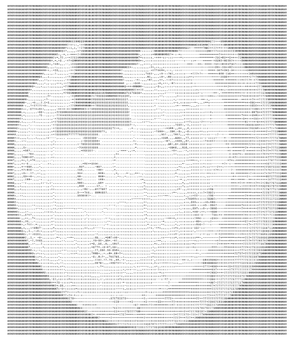
ASCII art version of the Wikipedia logo

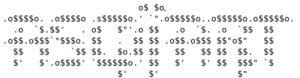
"Oldskool" or "Amiga" way
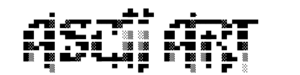
"Block" or "Loftier ASCII" style, cf. ANSI art

The alphabet in Newskool (Note: artificially shrunk vertically)

ASCII art is a graphic design technique that uses computers for presentation and consists of pictures pieced together from the 95 printable (from a full of 128) characters divers by the ASCII Standard from 1963 and ASCII compliant character sets with proprietary extended characters (beyond the 128 characters of standard 7-bit ASCII). The term is as well loosely used to refer to text based visual art in general. ASCII art tin be created with any text editor, and is ofttimes used with free-grade languages. Most examples of ASCII fine art crave a fixed-width font (not-proportional fonts, as on a traditional typewriter) such as Courier for presentation.
Amongst the oldest known examples of ASCII art are the creations past computer-art pioneer Kenneth Knowlton from around 1966, who was working for Bell Labs at the fourth dimension.[1] "Studies in Perception I" by Ken Knowlton and Leon Harmon from 1966 shows some examples of their early ASCII art.[2]
ASCII art was invented, in large role, because early printers often lacked graphics ability and thus characters were used in identify of graphic marks. Also, to mark divisions betwixt different impress jobs from unlike users, bulk printers often used ASCII art to impress large banner pages, making the partition easier to spot so that the results could be more easily separated by a figurer operator or clerk.[iii] ASCII art was besides used in early on e-mail when images could non be embedded.
History [edit]
Typewriter art [edit]
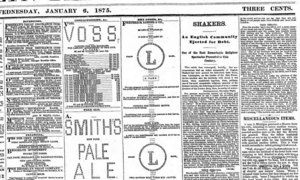
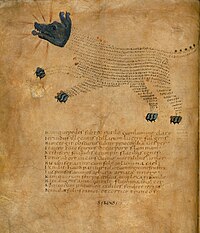
A portion of the Brooklyn Daily Hawkeye, 6 January 1875, showing advertisements made from typewriter art.
Since 1867, typewriters have been used for creating visual art.[ better source needed ] [iv] [5]
TTY and RTTY [edit]
TTY stands for "TeleTYpe" or "TeleTYpewriter", and is besides known as Teleprinter or Teletype. RTTY stands for Radioteletype; graphic symbol sets such every bit Baudot code, which predated ASCII, were used. According to a chapter in the "RTTY Handbook", text images accept been sent via teletypewriter as early on equally 1923.[6] Yet, none of the "quondam" RTTY art has been discovered yet. What is known is that text images appeared often on radioteletype in the 1960s and the 1970s.[7] [8]
Line-printer art [edit]
In the 1960s, Andries van Dam published a representation of an electronic circuit produced on an IBM 1403 line printer.[9] At the same time, Kenneth Knowlton was producing realistic images, also on line printers, by overprinting several characters on top of i some other.[2] Annotation that it was not ASCII fine art in a sense that the 1403 was driven past an EBCDIC-coded platform and the graphic symbol sets and trains available on the 1403 were derived from EBCDIC rather than ASCII, despite some glyphs commonalities.
ASCII art [edit]

There are 95 printable ASCII characters, numbered 32 to 126.
The widespread usage of ASCII art can be traced to the calculator bulletin board systems of the tardily 1970s and early on 1980s. The limitations of computers of that time period necessitated the use of text characters to correspond images. Along with ASCII's use in advice, nonetheless, it also began to appear in the underground online fine art groups of the menses. An ASCII comic is a course of webcomic which uses ASCII text to create images. In identify of images in a regular comic, ASCII art is used, with the text or dialog usually placed underneath.[10]
During the 1990s, graphical browsing and variable-width fonts became increasingly popular, leading to a refuse in ASCII art. Despite this, ASCII fine art connected to survive through online MUDs, an acronym for "Multi-User Dungeon", (which are textual multiplayer office-playing video games), Internet Relay Conversation, E-mail, message boards and other forms of online communication which ordinarily apply the needed fixed-width.[eleven]
ANSI [edit]
ASCII and more chiefly, ANSI were staples of the early technological era; terminal systems relied on coherent presentation using color and control signals standard in the terminal protocols.
Over the years, warez groups began to enter the ASCII fine art scene.[12] Warez groups usually release .nfo files with their software, cracks or other general software reverse-technology releases.[13] The ASCII art volition ordinarily include the warez group's name and perhaps some ASCII borders on the outsides of the release notes, etc.[xiv]
Bbs systems were based on ASCII and ANSI art, as were most DOS and similar console applications, and the precursor to AOL.
Uses [edit]

A tank and truck made using ASCII art
ASCII art is used wherever text tin be more readily printed or transmitted than graphics, or in some cases, where the transmission of pictures is not possible. This includes typewriters, teleprinters, non-graphic computer terminals, printer separators, in early reckoner networking (e.chiliad., BBSes), email, and Usenet news messages. ASCII art is too used within the source code of computer programs for representation of company or product logos, and flow control or other diagrams. In some cases, the unabridged source code of a program is a piece of ASCII fine art – for instance, an entry to one of the earlier International Obfuscated C Code Contest is a program that adds numbers, only visually looks like a binary adder drawn in logic ports.[15]
Some electronic schematic athenaeum represent the circuits using ASCII art.[xvi] [17] [xviii] [19] [20] [21] [22] [23] [24] [25] [26]
Examples of ASCII-style art predating the modernistic estimator era can be found in the June 1939, July 1948 and Oct 1948 editions of Pop Mechanics.[27]
Early on calculator games played on terminals frequently used ASCII fine art to simulate graphics, virtually notably the roguelike genre using ASCII art to visually stand for dungeons and monsters within them.[28] "0verkill" is a 2nd platform multiplayer shooter game designed entirely in colour ASCII art. MPlayer and VLC media thespian can brandish videos as ASCII art through the AAlib library. ASCII art is used in the making of DOS-based ZZT games.
Many game walkthrough guides come as part of a basic .txt file; this file oftentimes contains the name of the game in ASCII art. Such every bit below, discussion fine art is created using backslashes and other ASCII values in order to create the illusion of 3D.
Types and styles [edit]
Different techniques could exist used in ASCII art to obtain dissimilar artistic effects. Electronic circuits and diagrams were implemented by typewriter or teletype and provided the pretense[ description needed ] for ASCII.
"Typewriter-style" lettering, fabricated from individual letter characters:[29]
H H EEEEE L L OOO Westward W OOO RRRR Fifty DDDD !! H H East L Fifty O O W W W O O R R L D D !! HHHHH EEEEE 50 L O O Due west Due west Due west O O RRRR L D D !! H H E 50 L O O ,, West Westward O O R R L D D H H EEEEE LLLLL LLLLL OOO ,, W W OOO R R LLLLL DDDD !!
Line fine art, for creating shapes:
.--. /\ ____ '--' /__\ (^._.^)~ <(o.o )>
Solid fine art, for creating filled objects:
.thousand@8g. db 'Y8@P' d88b
Shading, using symbols with various intensities for creating gradients or contrasts:
:$#$: "4b. ':. :$#$: "4b. ':.
Combinations of the above, often used as signatures, for example, at the cease of an email:
|\_/| **************************** (\_/) / @ @ \ * "Purrrfectly pleasant" * (='.'=) ( > º < ) * Poppy Prinz * (")_(") `>>ten<<´ * (pprinz case.com) * / O \ ****************************
 As-pixel characters use combinations of ░ , █ , ▄ and ▀ (Block Elements) to make pictures:
▄▄▄▄▄▄▄░▄▄▄▄▄▄▄░▄▄▄▄▄▄░▄▄▄▄▄ ░░▀███░░░░▀██░░░░██▀░░░░██░░ ░░░▀██░░░░░▀██░░▄█░░░░░▄█░░░ ░░░░███░░░░░▀██▄█░░░░░░█░░░░ ░░░░░███░░░░░▀██░░░░░░█▀░░░░ ░░░░░░███░░░░▄███░░░░█▀░░░░░ ░░░░░░░██▄░░▄▀░███░░█▀░░░░░░ ░░░░░░░▀██▄█▀░░░███▄▀░░░░░░░ ░░░░░░░░▀██▀░░░░░███░░░░░░░░ ░░░░░░░░░▀▀░░░░░░░▀░░░░░░░░░
Emoticons and verticons [edit]
The simplest forms of ASCII art are combinations of 2 or 3 characters for expressing emotion in text. They are commonly referred to as 'emoticon', 'smilie', or 'smiley'. There is another blazon of ane-line ASCII art that does not crave the mental rotation of pictures, which is widely known in Nihon as kaomoji (literally "face characters".)
More than circuitous examples use several lines of text to draw large symbols or more than circuitous figures. Hundreds of different text smileys have developed over time,[30] but only a few are generally accustomed, used and understood.
ASCII comic [edit]
An ASCII comic is a grade of webcomic.
The Adventures of Nerd Boy [edit]
The Adventures of Nerd Boy, or but Nerd Male child, was an ASCII comic, published by Joaquim Gândara betwixt five August 2001 and 17 July 2007, and consisting of 600 strips. They were posted to ASCII art newsgroup alt.ascii-art and on the website.[31] Some strips have been translated to Polish[32] [33] and French.
Styles of the reckoner underground text art scene [edit]
Atari 400/800 ATASCII [edit]
The Atari 400/800, which were released in 1979, did not follow the ASCII standard and had their own character ready, called ATASCII.[34] [35] [ failed verification ] The emergence of ATASCII art coincided with the growing popularity of BBS Systems acquired past availability of the acoustic couplers that were compatible with the viii-bit abode computers. ATASCII text animations are likewise referred to as "break animations" by the Atari sceners.[eleven]
C-64 PETSCII [edit]
The Commodore 64, which was released in 1982, also did not follow the ASCII standard. The C-64 graphic symbol set is called PETSCII, an extended form of ASCII-1963. As with the Atari'south ATASCII art, C-64 fans developed a similar scene that used PETSCII for their creations.
"Block ASCII" / "High ASCII" way ASCII art on the IBM PC [edit]
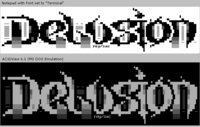
Block ASCII display via Notepad versus ACiDView for Windows
So-called "block ASCII" or "high ASCII" uses the extended characters of the 8-bit code page 437, which is a proprietary standard introduced by IBM in 1979 (ANSI Standard x3.16) for the IBM PC DOS and MS-DOS operating systems. "Block ASCIIs" were widely used on the PC during the 1990s until the Internet replaced BBSes every bit the main advice platform. Until then, "block ASCIIs" dominated the PC Text Art Scene.[36] [37]
The first art scene group that focused on the extended grapheme prepare of the PC in their fine art piece of work was chosen "Aces of ANSI Fine art" (<A.A.A>). Some members left in 1990, and formed a group called "ANSI Creators in Demand" (Acid). In that aforementioned yr the second major underground art scene grouping was founded, ICE, "Insane Creators Enterprise".[38]
There is some debate between ASCII and block ASCII artists, with "Hardcore" ASCII artists maintaining that block ASCII art is in fact non ASCII art, because it does not apply the 128 characters of the original ASCII standard. On the other hand, block ASCII artists argue that if their fine art uses only characters of the computers character set, so information technology is to be chosen ASCII, regardless if the character ready is proprietary or not.
Microsoft Windows does not back up the ANSI Standard x3.16. I tin view block ASCIIs with a text editor using the font "Concluding", simply it will not look exactly every bit it was intended by the creative person. With a special ASCII/ANSI viewer, such as ACiDView for Windows (see ASCII and ANSI art viewers), 1 can run across block ASCII and ANSI files properly. An instance that illustrates the difference in advent is part of this article. Alternatively, one could look at the file using the Type command in the command prompt.
"Amiga"/"Oldskool" style ASCII art [edit]

Oldschool/Amiga ASCII look on Commodore Amiga Computer versus look on the IBM PC (notice the tight spacing)
In the fine art scene i pop ASCII style that used the seven-flake standard ASCII character ready was the then-called "Oldskool" style. It is also called "Amiga style", due to its origin and widespread use on the Commodore Amiga computers. The style uses primarily the characters: _/\-+=.()<>:. The "oldskool" art looks more than like the outlined drawings of shapes than real pictures. This is an example of "Amiga style" (too referred to equally "onetime school" or "oldskool" style) scene ASCII art.[36]
The Amiga ASCII scene surfaced in 1992, seven years after the introduction of the Commodore Amiga m. The Commodore 64 PETSCII scene did not make the transition to the Commodore Amiga every bit the C64 demo and warez scenes did. Among the first Amiga ASCII art groups were Art, Epsilon Design, Upper Class, Unreal (afterwards known as "DeZign"). This means that the text art scene on the Amiga was really younger than the text art scene on the PC. The Amiga artists also did not call their ASCII art way "Oldskool". That term was introduced on the PC. When and by whom is unknown and lost in history.
The Amiga style ASCII artwork was well-nigh often released in the form of a single text file, which included all the artwork (usually requested), with some design parts in between, as opposed to the PC art scene where the fine art piece of work was released as a ZIP archive with separate text files for each piece. Furthermore, the releases were usually called "ASCII collections" and not "art packs" like on the IBM PC.
In text editors [edit]
_____ ___ ____ _ _ | ___|_ _/ ___| | ___| |_ | |_ | | | _| |/ _ \ __| | _| | | |_| | | __/ |_ |_| |___\____|_|\___|\__|
This kind of ASCII art is handmade in a text editor. Pop editors used to make this kind of ASCII art include Microsoft Notepad, CygnusEditor aka. CED (Amiga), and EditPlus2 (PC).
Oldskool font example from the PC, which was taken from the ASCII editor FIGlet.
Newskool style ASCII fine art [edit]
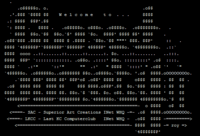
Newskool ASCII screenshot
"Newskool" is a popular course of ASCII art which capitalizes on graphic symbol strings similar "$#Xxo". In spite of its name, the mode is not "new"; on the contrary, it was very old but savage out of favor and was replaced by "Oldskool" and "Cake" style ASCII art. Information technology was dubbed "Newskool" upon its comeback and renewed popularity at the end of the 1990s.[36]
Newskool changed significantly as the event of the introduction of extended proprietary characters. The classic 7-bit standard ASCII characters remain predominant, but the extended characters are often used for "fine tuning" and "tweaking". The style developed farther afterward the introduction and accommodation of Unicode.
Methods for generating ASCII art [edit]
While some prefer to apply a simple text editor to produce ASCII art, specialized programs, such as JavE have been developed that frequently simulate the features and tools in bitmap paradigm editors. For Block ASCII art and ANSI art the artist about always uses a special text editor, because to generate the required characters on a standard keyboard, one needs to know the Alt code for each graphic symbol. For example, Alt+ane seven 8 will produce ▓, Alt+1 7 7 will produce ▒, and Alt+8 will produce ◘.
The special text editors have sets of special characters assigned to existing keys on the keyboard. Popular DOS-based editors, such as TheDraw and ACiDDraw had multiple sets of different special characters mapped to the part keys to make the use of those characters easier for the artist who can switch between individual sets of characters via basic keyboard shortcuts. PabloDraw is one of the very few special ASCII/ANSI art editors that were adult for Windows.
Prototype to text conversion [edit]
Other programs allow ane to automatically convert an image to text characters, which is a special case of vector quantization. A method is to sample the paradigm down to grayscale with less than 8-bit precision, so assign a grapheme for each value. Such ASCII art generators often allow users to choose the intensity and dissimilarity of the generated image.[39]
Three factors limit the allegiance of the conversion, peculiarly of photographs:
- depth (solutions: reduced line spacing; bold style; block elements; colored groundwork; practiced shading);
- sharpness (solutions: a longer text, with a smaller font; a greater set up of characters; variable width fonts);
- ratio (solutions with compatibility issues: font with a square grid; stylized without extra line spacing).
Examples of converted images are given below.
This is ane of the earliest forms of ASCII art, dating back to the early on days of the 1960s minicomputers and teletypes. During the 1970s, it was popular in U.s.a. malls to get a t-shirt with a photograph printed in ASCII art on it from an automatic kiosk containing a computer, and London's Science Museum had a similar service to produce printed portraits. With the advent of the spider web, HTML and CSS, many ASCII conversion programs will now quantize to a full RGB colorspace, enabling colorized ASCII images.
Still images or movies can also be converted to ASCII on diverse UNIX and UNIX-similar systems using the AAlib (black and white) or libcaca (color) graphics device driver, or the VLC media histrion or mpv nether Windows, Linux or macOS; all of which return the screen using ASCII symbols instead of pixels.[40]
There are also a number of smartphone applications, such as ASCII cam for Android, that generate ASCII art in real-time using input from the telephone'southward camera. These applications typically allow the ASCII art to be saved as either a text file or every bit an image made upwardly of ASCII text.
Non fixed-width ASCII [edit]
Nearly ASCII art is created using a monospaced font, such as Courier, where all characters are identical in width. Early computers in use when ASCII art came into vogue had monospaced fonts for screen and printer displays. Today, most of the more commonly used fonts in word processors, web browsers and other programs are proportional fonts, such as Helvetica or Times Roman, where different widths are used for different characters. ASCII art drawn for a fixed width font volition usually announced distorted, or even unrecognizable when displayed in a proportional font.
Some ASCII artists have produced fine art for display in proportional fonts. These ASCIIs, rather than using a purely shade-based correspondence, use characters for slopes and borders and use block shading. These ASCIIs by and large offer greater precision and attending to detail than fixed-width ASCIIs for a lower character count, although they are not equally universally accessible since they are usually relatively font-specific.
Animated ASCII art [edit]
Animated ASCII art started in 1970 from and then-called VT100 animations produced on VT100 terminals. These animations were just text with cursor motility instructions, deleting and erasing the characters necessary to announced animated. Ordinarily, they represented a long hand-crafted process undertaken by a single person to tell a story.
Gimmicky web browser revitalized animated ASCII fine art over again. It became possible to display animated ASCII art via JavaScript or Java applets. Static ASCII fine art pictures are loaded and displayed one afterward another, creating the blitheness, very similar to how picture projectors unreel film reel and project the individual pictures on the big screen at film theaters. A new term was born: "ASCIImation" – some other proper noun of blithe ASCII art. A seminal work in this arena is the Star Wars ASCIImation.[41] More than complicated routines in JavaScript generate more elaborate ASCIImations showing effects like Morphing effects, star field emulations, fading effects and calculated images, such as mandelbrot fractal animations.[42] [43]
There are now many tools and programs that tin can transform raster images into text symbols; some of these tools tin can operate on streaming video. For example, the music video for American singer Brook's song "Black Tambourine"[44] is made up entirely of ASCII characters that approximate the original footage. VLC, a media player software, can render whatever video in colored ASCII through the libcaca module.
Other text-based visual art [edit]
There are a diversity of other types of art using text symbols from character sets other than ASCII and/or some form of color coding. Despite not existence pure ASCII, these are nonetheless frequently referred to equally "ASCII fine art". The character set portion designed specifically for drawing is known every bit the line drawing characters or pseudo-graphics.
ANSI fine art [edit]
The IBM PC graphics hardware in text mode uses sixteen bits per graphic symbol. It supports a variety of configurations, only in its default mode under DOS they are used to requite 256 glyphs from one of the IBM PC code pages (Code page 437 by default), 16 foreground colors, eight background colors, and a flash selection. Such art tin be loaded into screen retentiveness directly. ANSI.SYS, if loaded, also allows such art to be placed on screen by outputting escape sequences that indicate movements of the screen cursor and color/flash changes. If this method is used then the art becomes known equally ANSI art. The IBM PC code pages also include characters intended for uncomplicated drawing which often made this art appear much cleaner than that made with more than traditional character sets. Plain text files are also seen with these characters, though they accept become far less common since Windows GUI text editors (using the Windows ANSI code folio) have largely replaced DOS-based ones.
Shift_JIS and Nippon [edit]

Monā ( モナー , Monā ) Posted on 2channel ( 2ちゃんねる , Nichanneru ) in 2000

Gikoneko ( ギコ猫 , Giko true cat ) Posted on 2channel ( 2ちゃんねる , Nichanneru ) in 2000
In Nippon, ASCII art (AA) is mainly known as Shift_JIS art. Shift JIS offers a larger pick of characters than manifestly ASCII (including characters from Japanese scripts and fullwidth forms of ASCII characters), and may exist used for text-based fine art on Japanese websites.
Often, such artwork is designed to be viewed with the default Japanese font on a platform, such as the proportional MS P Gothic.[45]
Kaomoji [edit]
Users on ASCII-Cyberspace, in which the give-and-take ASCII refers to the ASCII Corporation rather than the American Standard Code for Information Interchange, popularised a style of emoticon ( 顔文字 , kaomoji , emoticon) in which the confront appears upright rather than rotated.
| Icon | Meaning |
|---|---|
| (^_^) (^^ゞ (^_^;) (-_-;) (~_~;) (・。・;) (・_・;) (・・;) ^^; ^_^; (#^.^#) (^ ^;) | Smiley, nervous, embarrassed, troubled, shy, sweat drib |
Unicode [edit]
Unicode would seem to offer the ultimate flexibility in producing text based art with its huge variety of characters. However, finding a suitable fixed-width font is likely to be difficult if a significant subset of Unicode is desired. (Modern UNIX-style operating systems do provide consummate fixed-width Unicode fonts, east.g. for xterm. Windows has the Courier New font, which includes characters similar ┌╥─╨┐♥☺Ƹ̵̡Ӝ̵̨̄Ʒ). Also, the mutual practise of rendering Unicode with a mixture of variable width fonts is likely to make predictable brandish difficult, if more than a tiny subset of Unicode is used. ≽ʌⱷ҅ᴥⱷʌ≼ is an adequate representation of a cat's face in a font with varying character widths.
Control and combining characters [edit]
The combining characters machinery of Unicode provides considerable means of customizing the style, even obfuscating the text (e.g. via an online generator like Obfuscator,[46] which focuses on the filters[47]). Glitcher is one example of Unicode art, initiated in 2012: These symbols, intruding upwardly and downwardly, are made by combining lots of diacritical marks. It's a kind of art. At that place'south quite a lot of artists who use the Net or specific social networks as their canvas. [48] The respective creations are favored in web browsers (thanks to their always meliorate back up[49]), as geekily stylized usernames for social networks. With a fair compatibility, and among different online tools, [Facebook symbols] [fifty] showcases various types of Unicode art, mainly for aesthetic purpose (Ɯıḳĭƥḙȡḯả Wîkipêȡıẚ Ẉǐḳîṗȅḍȉā Ẃįḵįṗẻḑìẵ Ẉĭḵɪṕḗdïą Ẇïƙỉpểɗĭà Ẅȉḱïṕȩđĩẵ etc.). Likewise, the creations tin can be manus-crafted (by programming), or pasted from mobile applications (due east.one thousand. the category of 'fancy text'[51] tools on Android). The underlying technique dates back to the old systems that incorporated control characters, though. Eastward.thousand. the German composite ö would be imitated on ZX Spectrum past overwriting[52] " after backspace and o.
Overprinting (surprint) [edit]
In the 1970s and early 1980s it was popular to produce a kind of text art that relied on overprinting. This could be produced either on a screen or on a printer by typing a character, backing upwardly, and then typing some other character, but every bit on a typewriter. This developed into sophisticated graphics in some cases, such equally the PLATO system (circa 1973), where superscript and subscript allowed a wide diversity of graphic effects. A common use was for emoticons, with WOBTAX and VICTORY both producing disarming smiley faces.[53] Overprinting had previously been used on typewriters, simply the low-resolution pixelation of characters on video terminals meant that overprinting here produced seamless pixel graphics, rather than visibly overstruck combinations of letters on paper.
Beyond pixel graphics, this was also used for printing photographs, as the overall darkness of a item graphic symbol space dependent on how many characters, as well equally the option of character, were printed in a particular place. Thanks to the increased granularity of tone, photographs were oft converted to this blazon of printout. Even manual typewriters or daisy wheel printers could be used. The technique has fallen from popularity since all inexpensive printers tin can easily impress photographs, and a normal text file (or an e-mail bulletin or Usenet posting) cannot correspond overprinted text. However, something similar has emerged to replace information technology: shaded or colored ASCII art, using ANSI video terminal markup or colour codes (such as those constitute in HTML, IRC, and many internet message boards) to add a bit more tone variation. In this way, it is possible to create ASCII fine art where the characters but differ in color.
Run across too [edit]
- Micrography
- Types and styles: Alt lawmaking, ASCII stereogram, box-drawing characters, emoticon, FILE ID.DIZ, .nfo (release info file)
- Pre-ASCII history: Calligram, Concrete poetry, Typewriter, Typewriter mystery game, Teleprinter, Radioteletype
- Related art: ANSI fine art, ASCII porn, ATASCII, Fax art, PETSCII, Shift JIS fine art, Text semigraphics
- Related context: Bulletin board arrangement (Bulletin board system), Computer art scene, Category:Artscene groups
- Software: AAlib, cowsay
- Unicode: Homoglyph, Indistinguishable characters in Unicode
References [edit]
- ^ Carlson, Wayne E. (2003). "An Historical Timeline of Computer Graphics and Animation". Archived from the original on 2008-03-10. Retrieved 2008-03-05 .
- ^ a b Carlson 2003 "1966 Studies in Perception I by Ken Knowlton and Leon Harmon (Bell Labs)", Image of Studies in Perception I Archived four March 2016 at the Wayback Machine
- ^ Moritsugu, Steve (2000). Practical UNIX . Que Publishing. pp. 220–221. ISBN9780789722508.
banner.
- ^ Stark, Joan Thou. (2001). "The History of ASCII (Text) Art". Archived from the original on 2009-x-26. Retrieved 2008-03-05 .
- ^ Robert, Paul (2005-05-11). "Typewriter Art". The Virtual Typewriter Museum. Retrieved 2008-03-05 .
- ^ Green, Wayne (June 1972). RTTY Handbook. Blue Ridge Peak, Pennsylvania: G/L Tab Books. ISBN0-8306-2597-6.
- ^ Stark, Joan G. (2000). "Development OF (ASCII) TEXT Art". Archived from the original on 2009-10-26. Retrieved 2008-03-05 .
- ^ "New Page". www.rtty.com . Retrieved 2017-10-19 .
- ^ "A compact data structure for storing, retrieving and manipulating line drawings" past Andries Van Dam & David Evans
- ^ Chute, Hillary L.; Jagoda, Patrick (2014-07-11). Comics & Media: A Special Issue of "Critical Inquiry". University of Chicago Press. ISBN978-0-226-23908-eight.
- ^ a b Untitled. webcache.googleusercontent.com. ISBN978-1-283-48829-7 . Retrieved 2020-05-07 .
- ^ Necromancer (1998-03-06). "History of the PC Ascii Scene". textfiles.com. Archived from the original on 2008-02-15. Retrieved 2008-03-05 .
- ^ Defacto2 (2008). "Defacto2 – Scene Documents, text and NFO files". defacto2.net. Archived from the original on 2008-03-12. Retrieved 2008-03-05 .
- ^ NFO Files drove at Defacto2.net, with NFO files that appointment dorsum to 1989. Retrieved 17 Feb 2008.
- ^ Downs, Makarios. "xvi fleck addition the easy/hard way".
- ^ "Certificate Markup Format". Archived from the original on 2004-06-26.
- ^ "Circuits Archive"
- ^ "Sci.electronics FAQ: Assorted ASCII Schematics". www.repairfaq.org.
- ^ Cunningham, Collin (2010-02-04). "Schematics simply look cooler in ASCII". Make:. Archived from the original on 2016-09-11.
- ^ "ASCII Circuits"
- ^ Paul, Matthias R. (2005-12-12). "Minolta SR-T Batterieadapter" [Using a Bandgap voltage reference as Mercury battery replacement]. Minolta-Forum (in German). Archived from the original on 2016-x-11. Retrieved 2011-02-26 .
- ^ Paul, Matthias R. (2009-03-14). "Minolta SR-T Batterieadapter" [Using a 7×seven mm SMD transistor-based low-side voltage regulator excursion as Mercury bombardment replacement]. Minolta-Forum (in German). Archived from the original on 2016-03-27. Retrieved 2011-02-26 .
- ^ Paul, Matthias R. (2005-03-07). "Eigenbau eines Kabelauslösers - Problem mit der Funktion…" [Edifice your own remote camera trigger - problem with office…]. Minolta-Forum (in German). Archived from the original on 2016-03-31. Retrieved 2016-03-31 .
- ^ Paul, Matthias R. (2009-04-26) [2007-11-01]. "Funkblitzauslöser PT-04 m. Minolta-Rush 5600HS(D) - Funkauslöser funktioniert, aber Blitz löst trotzdem nicht aus" [Wireless remote flash control PT-04 with Minolta flash 5600HS(D) - wireless triggering works, but all the same flash does not fire]. Minolta-Forum (in German). Archived from the original on 2016-06-06. Retrieved 2016-06-06 .
- ^ Paul, Matthias R. (2010-04-09) [2009-04-17]. "Car-Off-Deaktivierung bei Minolta Plan 4000 AF - Automatische Abschaltung des 4000 AF für Slave-Betrieb deaktivieren?" [Deactivating motorcar-off function of Minolta Program 4000 AF]. Minolta-Forum (in High german). Archived from the original on 2016-03-27. Retrieved 2016-03-27 .
- ^ Paul, Matthias R. (2012-05-09). "Innenschaltung Minolta PC Terminal Adapter Percent-100" [Internal circuitry of Minolta PC Terminal Adapter PCT-100]. Minolta-Forum (in German language). Archived from the original on 2016-08-04. Retrieved 2016-08-04 .
- ^ Cumbrowski, Carsten (2007-02-14). "Keyboard Text Fine art From Over Twenty Years Before ASCII". roysac.com . Retrieved 2008-03-05 .
- ^ Valentin, Christian (2016-10-17). "Roguelikes Aren't Done With ASCII Fine art Nevertheless". Kill Screen . Retrieved 2020-01-04 .
- ^ Paul, Matthias R. (1997-07-30) [1994-05-01]. NWDOS-TIPs – Tips & Tricks rund um Novell DOS 7, mit Blick auf undokumentierte Details, Bugs und Workarounds [NWDOS-TIPs - — Tips & tricks for Novell DOS 7, with a focus on undocumented details, bugs and workarounds]. MPDOSTIP. Release 157 (in High german) (3 ed.). Archived from the original on 2017-09-10. Retrieved 2014-08-06 . (NB. The height of the NWDOSTIP.TXT file shows a big text logo in typewriter-style art.) [1]
- ^ textfiles (2008). "Collection of ASCII Smileys". Archived from the original on 2008-03-x. Retrieved 2008-03-05 .
- ^ Gândara, Joaquim (2006). "The Adventures of Nerd Boy—Episodes 1-635". Nerd-Boy.cyberspace. Retrieved 2008-03-05 .
- ^ Wilk 2006 episodes 1 to 172
- ^ nb-pl.jogger.pl 2006 episodes 208 to 470
- ^ Štěrba, Radek (2005-12-20). "ATASCII". Archived from the original on 2005-12-twenty. Retrieved 2005-12-20 . (gif image)
- ^ Moeser, David; Fusik, Piotr (2007-05-13). "7.ii: What is the ATASCII grapheme set?". faqs.org. Retrieved 2008-03-05 .
- ^ a b c Roy/SAC. "The Three ASCII Art Styles of the Underground Text Art Scene". www.roysac.com . Retrieved 2017-10-19 .
- ^ An Abbreviated History of the Hush-hush Reckoner Art Scene by Napalm, xi October 1998, The History of Fine art and Applied science
- ^ 100 YEARS OF THE COMPUTER Fine art SCENE, Presented past Jason Scott Sadofsky and RaD Man (Acid), Notacon Briefing – Cleveland, Ohio, Us, 23–25 Apr 2004.
- ^ "ASCII Fine art Generator: An Overview". asciiartgenerator.internet. 2012-01-12. Archived from the original on 2013-08-01. Retrieved 2012-03-19 .
- ^ "54. Sentry Videos in ASCII Art - Linux Multimedia Hacks [Book]". www.oreilly.com.
- ^ Jansen, Simon (2006-04-18). "Star "ASCIImation" Wars". Asciimation.co.nz. Archived from the original on 2008-12-09. Retrieved 2008-11-eighteen .
- ^ ASCII Blitheness "Morph" by SkyLined (using JavaScript) includes morph effects and mandelbrot fractal animation
- ^ ASCII Blitheness Starfield by SkyLined (using JavaScript) includes fading effect and horizontal scrolling star field emulation
- ^ BeckVEVO (2009-x-07). "Brook - Black Tambourine". Retrieved 2017-10-19 – via YouTube.
- ^ "Mona Font". monafont.sourceforge.cyberspace . Retrieved 2017-10-19 .
- ^ "Online Text Obfuscator". obfuscator.uo1.net.
- ^ "web services - Should Unicode be immune in usernames?". Stack Overflow.
- ^ Zakas, Laimonas. "Facebook Page Performance Art Glitchr". TechCrunch. AOL. Retrieved 2015-06-23 .
- ^ "Unicode three.2 exam page". www.ltg.ed.ac.uk.
- ^ "Facebook profile name way with symbols (fb name font generator)". fsymbols.com.
- ^ "fancy text - Android Apps on Google Play". play.google.com.
- ^ "Earth of Spectrum - Documentation - ZX Spectrum manual - Chapter 16". www.worldofspectrum.org.
- ^ PLATO Emoticons, revisited, Brian Dear, PLATO History: Remembering the futurity, 19 September 2012
Further reading [edit]
- Beal, Vangie (2008). "Text Messaging Abbreviations: A Guide to Understanding Online Conversation Acronyms & Smiley Faces". Webopedia. Archived from the original on 2008-03-06. Retrieved 2008-03-05 .
- Carlsson, Anders; Miller, A. Neb (2012). "Time to come Potentials for ASCII art". Archived from the original on 2014-07-08. Retrieved 2014-07-08 .
- Cumbrowski, Carsten (2007-11-02). "History of Text Art Video by RaD Man / Acid". roysac.com. Archived from the original on 2008-03-02. Retrieved 2014-03-29 .
- Jones, Mike (2002-09-12). "The First Smiley :-)". Microsoft Research. Archived from the original on 2008-03-05. Retrieved 2008-03-05 .
- nb-pl.jogger.pl (2006). "[ Nerdboy PL ]". Archived from the original on 2006-05-14. Retrieved 2006-05-14 . (Smooth translators: Ania Górecka [ag], Asia Mazur [equally], Błażej Kozłowski [bug], Janusz [jp], Łukasz Dąbrowski [luk], Łukasz Tyrała [lt.], Łukasz Wilk [wilu], Marcin Gliński [fsc])
- Wilk, Łukasz (2006). "Strona grupy dyskusyjnej PL.REC.ASCII-ART" (in Polish). Archived from the original on 2006-01-15. Retrieved 2006-11-thirty .
- Wirth, Christian (2007). Building Character: ANSI From the Ground Up. Notacon. Retrieved 2013-07-07 .
External links [edit]
 | Wikimedia Eatables has media related to ASCII art. |
- ASCII art at Curlie
- media4u.ch - ASCII Fine art (ASCII Art Movie. The Matrix in ASCII Fine art)
- TexArt.io ASCII Art drove
- Textfiles.com archive
- Sixteen Colors ANSI Art and ASCII Art Archive
- Defacto2.cyberspace Scene NFO Files Archive
- Chris.com ASCII art collection
- "Every bit-Pixel Characters" ASCII art collection
- ASCII Fine art Animation of Star Wars, "ASCIIMATION"
- ASCII Keyboard Art Drove
- Animasci
Source: https://en.wikipedia.org/wiki/ASCII_art
0 Response to "Two in the Pink and One in the Stink Ascii Art"
Post a Comment